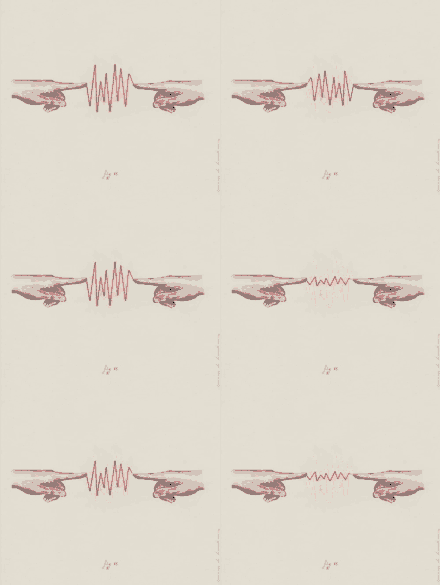
To borrow our idea of a dinner party, I see Turkle and Wesch as the type of guests who remain at the table after the plates have been cleared, talking passionately about where their positions overlap and diverge. I foresee Turkle insisting that her research suggests that the average individual’s phone use isolates them from the world whereas Welsch acknowledges her work but counters by citing his classroom experiences as spaces where technology is used as a means by which his students can connect with one another and display their learning, not just with each other but with the world at large.
Based on the information presented in their pieces, I would also argue that both accept the belief that today’s youth are digital natives (as defined by Presnky), however, I suspect that if Boyd was also invited to this party Turkle would look to her for support in sighting that our youth still require direct instruction to develop the skills for utilizing technology responsibly. I see this connection most clearly when Turkle is describing her theory of the Goldilocks effect: “But what might feel just right for that middle aged executive can be a problem for an adolescent who needs to develop face-to-face relationships'' (Turkle, 2012). Here, Turkle’s point reminds me of Boyd’s main criticism of Prensky’s: that one cannot assume all youth are digital natives due to the fact that not all have the same level of access to technology as well as the skills required to critically consume media.
That said where Turkle would find an ally, I think Wesch would find an opponent. Specifically, I think Wesch would push back on the idea that our youth require direct instruction to obtain the skills and knowledge they need to be successful in life. According to Wesch (2010), “the best learning almost always occurs in the absence of a teacher, for it is then that learners are free to pursue with great passion the questions that are meaningful and relevant to their own lives (p. 5). Wesch’s laissez faire approach to instruction suggests that he believes today’s youth have the capacity to answer their own questions and learn the skills they need based on their life experiences; teachers are merely facilitators of the learning space (and not the sources of knowledge). Here I am reminded of the work of William Ayers and his belief that “greatness in teaching engages students, interacts with them, draws energy and direction from them, and offers reasons to plunge into classroom life” (Ayers & Alexander-Tanner, 2010, p. 97). Simply put, the students drive the instruction.
At the end of the day, once the dishes are cleared, I see Wesch and Turkle coming to a compromise: youth today require authentic connection. Although the path to fostering authentic connections may vary, the ultimate goal is to create a learning environment where youth can deepen their understanding of themselves, those around them, and the world at large.



Alyssa, I loved how you described both Turkle and Wesch the people to stay at the dinner table after the meal is done. I agree with you that they seem to be people who have great conversations and discussions. I like how you pointed out how Turkle and Wesch may disagree in regards to how technology should be taught. I did not think of that!
ReplyDeleteAlyssa, I like how you described the respectful, stimulating conversation that Turkle and Wesch would likely have, talking about their research and ideas. I visualize Wesch asking question after question, inspiring thought-provoking questions from Turkle. They would probably talk about the importance of meaningful connections and face-to-face conversations in our media-saturated world.
ReplyDeleteHi Alyssa,
ReplyDeleteI really like your analysis of these two different presentations. I agree with you that Turkle probably would not have much of a problem with the way that Wesch is using technology with his students. Turkle's presentation warns us that technology can take us places we do not want to go, and I do not think that Wesch is attempting to take us to one of those places. I really liked that you discuss that Wesch may have a problem with Turkle though. I really had not considered that when I did my post, and I think you may be right in that argument. I found your post really interesting, and it definitely provides a lot for discussion regarding these two presentations. I look forward to reading more of your posts. I really like the layout of your blog as well. Take care.